"Rigoletto," "Le Roi s'amuse," and the Reality of Rape
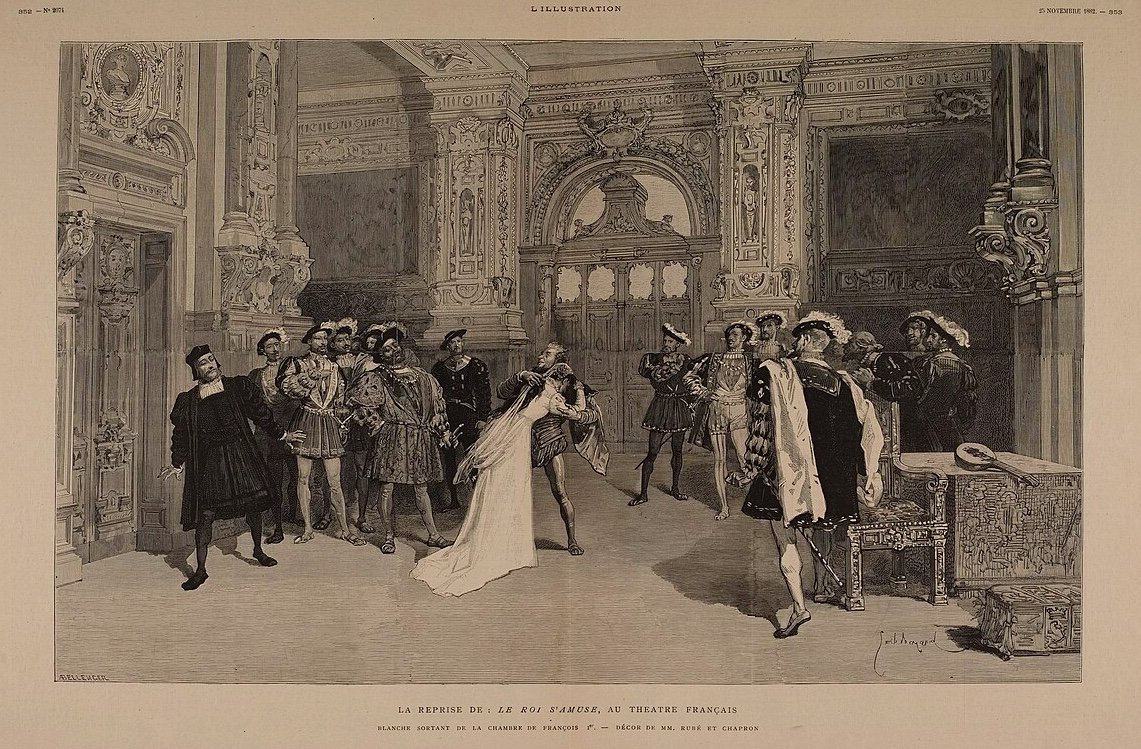
Blanche falls weeping into her father’s arms after her assault, in Act 3 of Le roi s’amuse. Engraving of an 1882 production, via Wikimedia Commons.

Let me tell you about why I wanted to do a new translation of Victor Hugo’s Le Roi s’amuse.
Oh, I’m not saying there was just one reason. There are certain practical considerations that led me here. I have degrees in Drama and French; I think 19th-century French verse melodramas are hugely underrated in Anglo theater; I did a translation of Cyrano de Bergerac several years ago so I have some experience with this sort of thing. Furthermore, Le Roi s’amuse is the basis for Verdi’s popular opera Rigoletto, which the San Francisco Opera produced in their 2025-26 season. So I thought perhaps my hometown opera company might be interested in a new translation by a local playwright.
(I was right! This spring, I have been leading a community workshop of my Le Roi s’amuse translation, in collaboration with SF Opera’s Department of Diversity, Equity, and Community. We are giving a free public performance at the SF Main Library on the afternoon of Sunday, April 19. More information here.)
But if we’re talking about the deep, emotional pull—what turned this project from a whim into a necessity—it was Act 3, Scene 2.
This scene is the heart of the play, almost literally: my translation is 85 pages long, and this scene begins on page 44. And it’s the play’s turning point. Before it occurs, there’s still a chance that the story could turn out all right—without ruination, bloodshed, or despair. After it, the tragic ending is inevitable. The hunchbacked jester will be moved to fury, hatch a plot for revenge, and have it all blow up in his face. Meanwhile, his daughter will sacrifice her life for the sake of a worthless cad.
I wrote “the jester” and “his daughter” there, rather than using the characters’ names, because the most obvious difference between Hugo’s play and Verdi’s opera is the names of people and places. Hugo’s play is a historical drama, set in the French court of King François I in the early 1520s and including several other historical figures. This made the play highly controversial; it received only a single performance at the Comédie Française in 1832 before the French censors shut it down. Twenty years later, when Verdi and his librettist Piave wanted to adapt the play into an opera, the censors in Northern Italy were equally wary. So in Verdi’s version, King François I of France becomes the Duke of Mantua (no first name given), the jester Triboulet becomes the jester Rigoletto, and his daughter Blanche becomes his daughter Gilda. The setting becomes a somewhat nebulous Renaissance Italian court as opposed to Hugo’s specific 1520s French court.
Opera fans may be more familiar with another instance of censors forcing Verdi to change an opera’s setting and characters. Un ballo in maschera was based on the 1792 assassination of King Gustav III of Sweden, but the censors thought it was too inflammatory to show a legitimate, non-fictional monarch getting assassinated onstage. So when the opera premiered, it was set in Colonial Boston (!) and the victim is merely a governor. (However, many modern-day productions, including SF Opera’s in 2024, restore the Swedish setting and character names.)
Still, unlike Un ballo, the heart-wrenching melodrama of Le Roi/Rigoletto is that the King/Duke doesn’t get assassinated. There’s a plot against his life, but he escapes, and the jester’s daughter ends up dead instead. So then, what’s the controversy? Isn’t Victor Hugo saying “Don’t seek revenge, it will only backfire”? And isn’t that a nice, conservative moral that flatters the status quo?
Well, no—because this is Victor Hugo we’re talking about, the champion of the oppressed and miserable, the man who went into voluntary exile rather than bend the knee to Emperor Napoleon III (admittedly, this happened two decades after he wrote Le Roi s’amuse). Even though Triboulet’s scheme doesn’t go as planned, you come away from the play thinking he was 100% correct to want revenge. His monologue of triumphant exultation when he thinks his plot has succeeded (“He who licked your boots, now eats your heart!”) is incredibly stirring—along with him, we want that corrupt tyrant to die! The moral of the story isn’t “respect the status quo and don’t plot against the king,” it’s “if the king rapes your 16-year-old daughter, maybe you’d be justified in hiring a hit man to kill him.”
Okay, now you’re starting to see why I felt so compelled to translate this play in Summer 2025, right?
Because, let’s speak frankly here: Act 3, scene 2, the heart of the play, is a scene of sexual assault. It’s not graphic or explicit—this was written in 1832, after all, and certain things couldn’t be shown onstage. So perhaps a better way to describe it is as the prelude to a sexual assault; a trap slowly closing around a frightened young girl until she literally has nowhere to run.
And, while the actual rape happens offstage, there’s no doubt in the mind of the audience or the characters about what took place. The King tries to seduce Blanche or at least gain her nominal consent. She rebuffs him several times, but he keeps pushing. In desperation, she spies an open door and runs through it into the next room. The King smirks at the audience and reveals that she’s fled into his own bedchamber, and “I have the key on me.” He follows her inside. Then there’s an agonizing scene where Blanche’s father Triboulet comes looking for her, while the courtiers try to throw him off her trail—and all the while, the audience knows all too well what’s happening behind that closed bedroom door. Finally Blanche stumbles out of the bedchamber, weeping and disheveled, barely able to speak for shame. Though Hugo never uses the French words for “rape” (viol/violer), preferring euphemisms like “[He stained] your spotless brow with shame and scorn” (my translation), all the circumstances add up to rape.
To my mind, this makes Le Roi s’amuse an exception among classical plays. In Measure for Measure, Shakespeare shows an understanding of why it’s wrong for powerful men to demand sex from women; but then that play (and several others of his) resolves with “the bed trick,” which, as non-consensual sex, is a form of rape. Feminist playwright Aphra Behn used the bed trick, too. Audiences have been arguing for nearly 250 years about whether Don Giovanni is a rapist or merely a “seducer.” I suppose Beaumarchais’ The Marriage of Figaro (the source for my favorite opera) is another old French play about how aristocrats shouldn’t treat women as sexual playthings, but it’s a much lighter and funnier treatment of the theme, and no one actually gets sexually assaulted in it. Obviously I haven’t read every work of classical European drama, but Le Roi s’amuse is the earliest play I can think of where there’s a rape, and the playwright knows that it’s a rape, and knows that it’s an unambiguously terrible thing.
And even though conversations about sexual assault, and fictitious depictions of rape, are much more common in 2026 than they were in 1832, Victor Hugo’s writing in Act Three still has the power to shock. (I know of at least one person who signed up to participate in my community workshop, then dropped out after they read the play and found it “nasty.”) It’s an unflinching scene. Hugo forces you to look because he wants to spark your outrage, the same outrage that Triboulet feels when he realizes what’s happened to his daughter. Moreover, Hugo mentions several times that Blanche is only 16. The first time I read that, I admit it made me uncomfortable; I wanted to look away. But then I realized that Hugo wants you to have that reaction. He wouldn’t mention Blanche’s age so many times unless it was really important.
Verdi’s adaptation, however, pulls its punches. For one thing, it never explicitly states Gilda’s age—and since she is often played by superstar sopranos in their 30s or 40s, the audience can forget that she’s meant to be very young. And, most notably to my mind, Verdi cuts Act 3 scene 2.
That’s right: the heart of Hugo’s play, the most powerful scene in it, appears nowhere in Verdi’s opera. This surprised me, especially because opera thrives on heightened, heart-wrenching emotion. If he’d wanted to, surely Verdi could have turned Hugo’s emotionally charged dialogue into an emotionally charged vocal duet. But ultimately, Verdi flinched. Hugo forces the audience to watch the trap close around Blanche; Verdi decided it would be better to look away.
This means that Act Two of Rigoletto (the equivalent of Act Three of Le Roi s’amuse) is more confusing and less honest than the play. It opens with the Duke alone onstage, singing a very sincere, pure-hearted aria about how much he loves Gilda. It’s like for three minutes, he becomes a totally different character. His other big arias are about how all women are interchangeable, and all women are fickle—but now, when he’s alone with his thoughts, they sound like a standard-issue romantic tenor love song? Then the courtiers inform the Duke that Gilda has been brought to the palace; he rushes off, and we do not see him again for the rest of the act. As in the play, Gilda eventually stumbles onstage and falls weeping into her father’s arms, ashamed of her behavior—but since opera audiences have not seen her interaction with the Duke, they may assume that she gave some level of consent. Just last summer, commenters on a popular opera blog were debating whether or not Gilda is raped or “seduced.” The omissions of the opera libretto mean that you can imagine a “he said, she said” scenario that works in the Duke’s favor. But watching the scene that Hugo wrote, you can’t do anything but condemn the King.
I know that opera, theater, and literature are often great ways to explore thorny ethical questions and ambiguous interpersonal situations. Many things in life are not clear-cut morally, and, along with many critics, I deplore a recent trend toward literalism and simplistic morals in popular art.
But, look: I was born in 1987. I learned the phrase “blow job” at age 10, because the President of the United States had had an ethically murky affair with a barely-legal intern. Two decades after that, an odious man was caught on tape bragging “Grab ‘em by the pussy—when you’re a star, they let you do it”—and now that man has twice been elected president over far more qualified women. The second victory, his first popular-vote win, happened after this man was found liable for sexual abuse, and after it became public knowledge that he had been a longtime associate of a pedophilic groomer who pimped out vulnerable girls to rich men. As I write this, one of the front-running candidates for governor in my state has just been accused of sexual harassment and assault by multiple younger women.
So can you blame me for feeling grateful that in 1832, Victor Hugo clearly understood how powerful men assault vulnerable women, and dramatized this with full-throated outrage? A clarity and outrage greater than many people in the 21st century are able to muster?
(I will also say that, while I am grateful Victor Hugo left nothing ambiguous about Blanche’s rape, I do think his play raises other valuable ethical questions that aren’t so straightforward. Triboulet is an overprotective father who keeps Blanche sheltered—was that the right thing to do or did it make her situation worse? And was hiring the hit man really the best way to get revenge?)
In 2017, at the height of the MeToo movement, theater critic Alexis Soloski wrote in an essay for the New York Times, “Is it too much to ask for a play that confirms the truth of an assault? Or suggests that a victim wasn’t somehow asking for it? How about a play in which a character who has been harassed or abused is supported and believed?”
Well, Victor Hugo wrote such a play in 1832. He called it Le Roi s’amuse.
Or, in my translation, When You’re the King, They Let You Do It.
UPDATE 4/14/26: A few days after I posted this, I read the article “Gilda Seduced: A Tale Untold,” by Elizabeth Hudson, originally published in Cambridge Opera Journal in 1992. Hudson analyzes the disconnect between Act Two of Rigoletto and Act Three of Le Roi, making the same point I do that “in a libretto remarkable for its closeness to the action of the original play, the missing confrontation between the Duke and Gilda remains the only major discrepancy between the libretto and its source.” But it turns out that, once again, this is the fault of those pesky Venetian censors! (They even thought it was too scandalous to have the Duke mention the key to his bedchamber, even if Gilda did not appear onstage at that point.) Verdi did hope to write music for a version of Hugo’s Act 3, scene 2, and even a year after Rigoletto premiered, he was still thinking about it. Hudson quotes and translates an impassioned letter from Verdi: “There would be one place [for a new scene], but, God help us, we would be scourged. We would need to show Gilda with the Duke in his bedroom!!! You understand me? In any case it would be a duet. A magnificent duet!! But the priests, monks, and hypocrites would scream at the scandal.”
So, my apologies to Verdi; I should have known that he wasn’t the person who flinched from this scene, and that with his immense talents as an opera composer, he would recognize it as a “magnificent” missed opportunity for a duet!